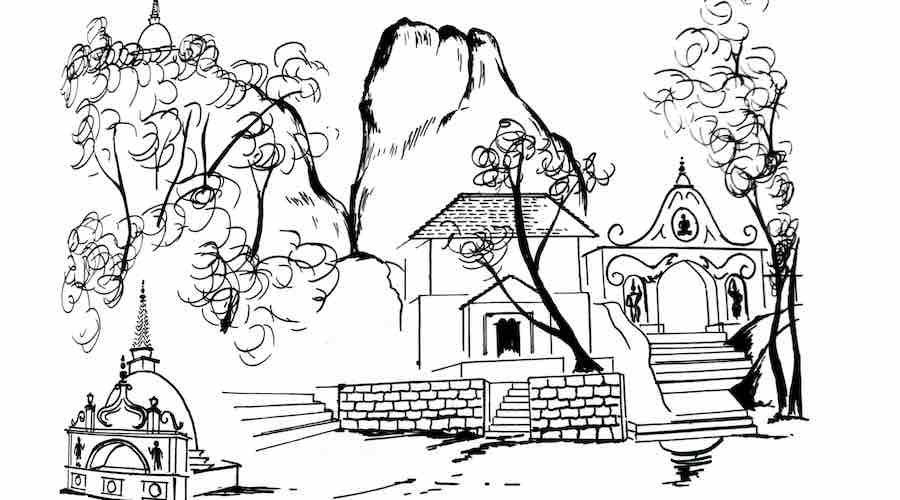

Stupa on the boulder
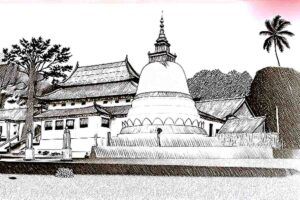
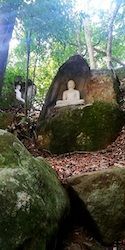
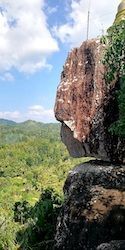
Or to give it its full name, Molagoda Kota Mudungala Raja Maha Vihara in the Nampotha, it is referred to as Gal-lale Vihara. It’s a picturesgque old temple in the Harispattu, and according to legend it rightly belongs to Valagambha’s time. The name originates from the vehera or ceitiya that sits atop one of the two high-rise boulders (mudun gale = atop the rock; vehera = ceitiya). The twin boulders are best seen from afar across the paddy fields, when approaching the vihara from Bokkawela village. To ascend to the cetiya it requires some skill and a track through a forested path with many sedant Budha statues on its path.
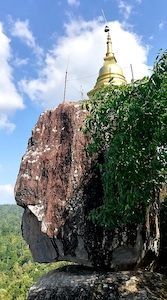
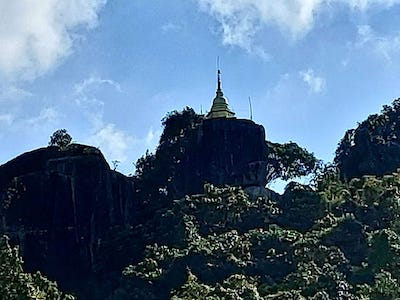
The Stupa is best viewed from the road below as its hidden amidst the thick growth of trees and creepers
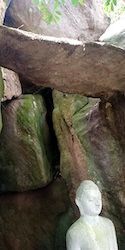
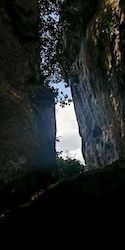
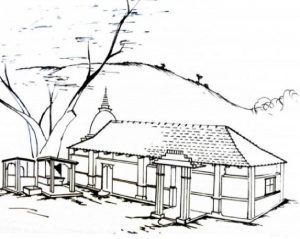
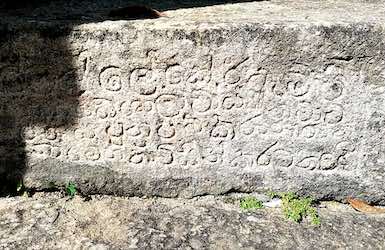
The original cave which still functions as a budu-gé is supposed to have been one of the many cave retreats of Valagambha during his 14-year exile. After Valagambha had returned to power he converted it into a temple. A drip ledge, and an inscription below it, appears to confirm this.
The other buildings and structures, apart from the three images within the old cave temple, belong to the Kandyan period.
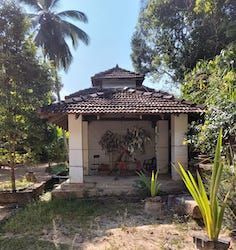
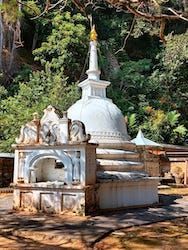
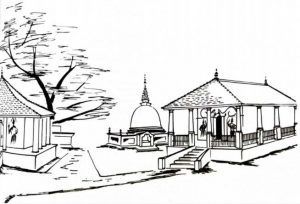
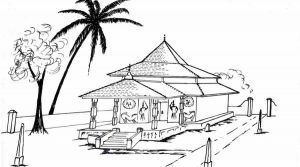
The complex today consists of pansala, two ceitiyas, a devale, a recently- built gal-pilimage, and at the far end, the old cave temple with a large footprint carved into a flat rock just behind a huge forana that separates the old vihara from the newer structures.
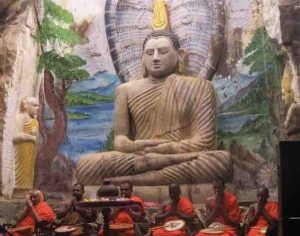
The gal-pilimage was constructed as recently as 1930, and contains a large sedant Buddha image, and two other standing figures, one of the recent Incumbents on the left of the main image and on its right, a statue of Valagambha. All three statues are carved in the round and out of stone.
An ancient cave temple
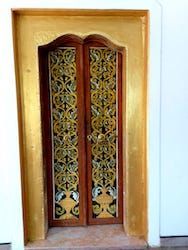
The old vihara, ie., the cave temple, has a front vestibule with its inside walls decorated with recent paintings of the 24 suvisi Buddhas. A closed door leads to the inner sanctum within the cave proper.
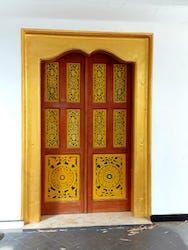
Here directly opposite the door are several Buddha images moulded out of plaster; a sedant Buddha image at each end and between them numerous other small Buddha images both sedant and standing. Above the two end images are several guardian deities (Natha, Vishnu, Saman, etc.). Lying along each side wall of the cave is, on the right, a large reclining Buddha image, and along the left a large sedant Buddha image.
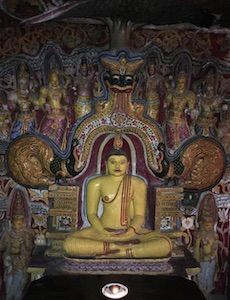
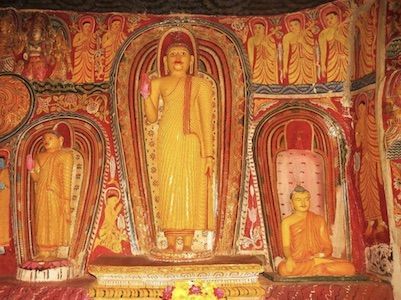
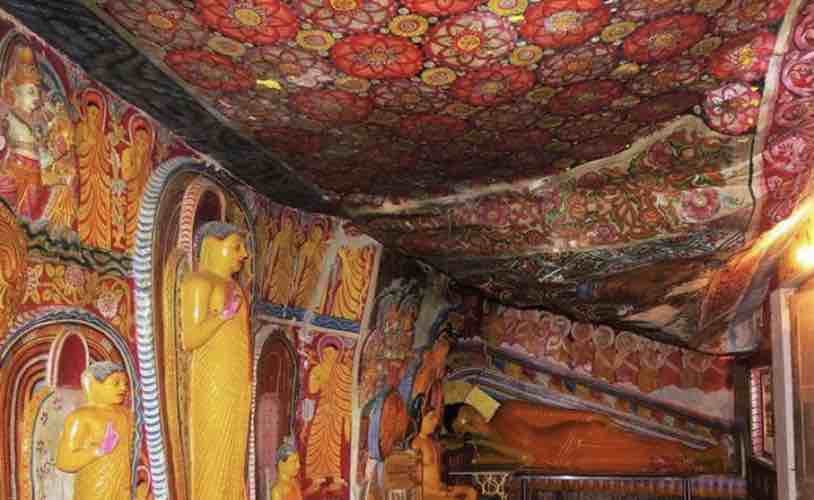
Apart from the images, both large and small, lying against the far wall, all the other images are recent.
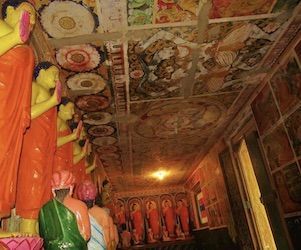
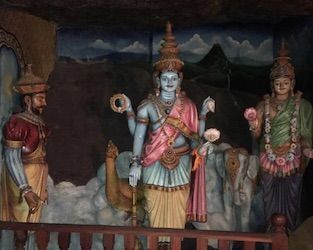
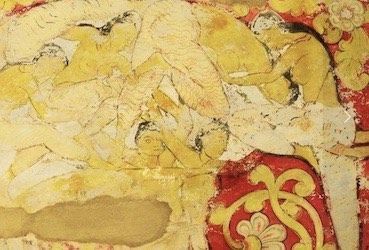
However most of the rock paintings appear to be at least from 17th century.
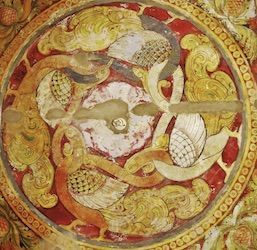
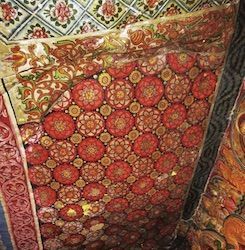
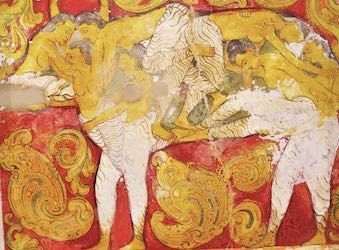
An interesting feature is the formation of animal figures using human construct.
Outside the old vihara, just within the huge torana, is a flat rock-face with a footprint of the Buddha carved on it.
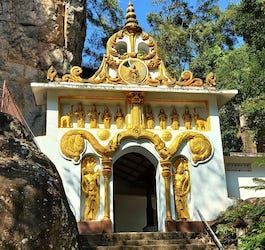
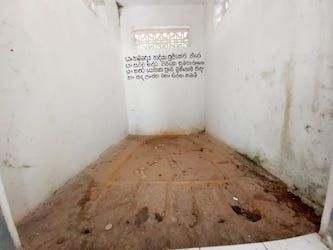
Beyond the torana ie., on the outside in the middle of the courtyard is a ceitiya, and further out still at the far end of the courtyard, is a small devale, all of the Kandyan period.
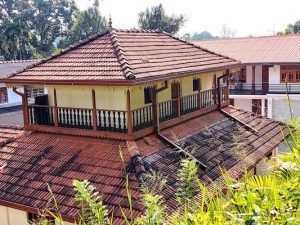
The pansala lies at a lower level on the left, while way down in the valley below, but clearly discernible, is an adahana dagoba in which are buried the ashes of earlier mahanayakas of the temple.
The steps tell another story
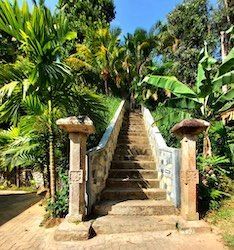
The steps leading up to the older structures described earlier have stone steps inscribed.
The two huge rock boulders stand upright against the sky and glimpses of the old ceitiya perched on one of them may be seen through the foliage in the middle-ground.