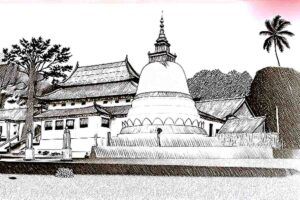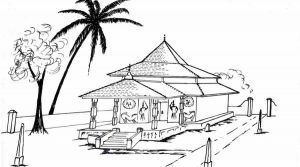

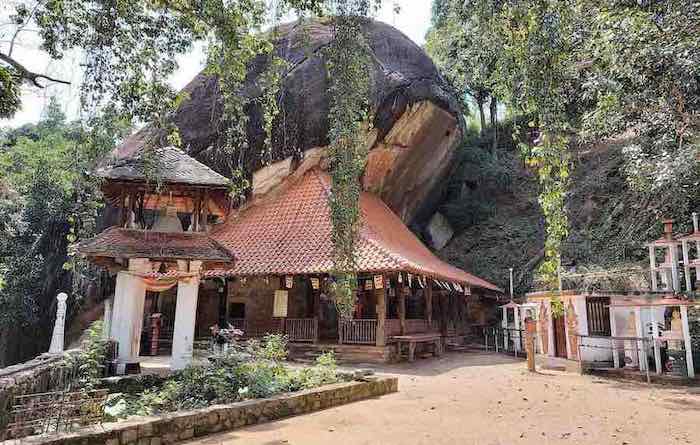
An ancient cave temple in Hewaheta. It is a mere 6 miles from Kandy on the new Galaha Road.
The original temple is believed to have existed in the 6th or 7th century A.D., judging from the painting techniques and the pigments used in the execution of the paintings on the rock face above the vihara.

Kandyan period Temple restored in 19th century
The present vihara clearly belongs to the Kandyan period circa 18th century, in fact the murals within the cave are definitely 18th century and this would date the present viharaya. Subsequent to this date, it was restored by Governor Edward Barnes in the 1820’s. More recently, in 1960, the lean-to roof of the temple was partly destroyed by fire, but has since been restored. Most of the murals and images within were unaffected, but the paintings on the rock face outside were almost completely destroyed, assisted of course by exposure to the elements both before and after the fire. Today, they are almost indiscernible.
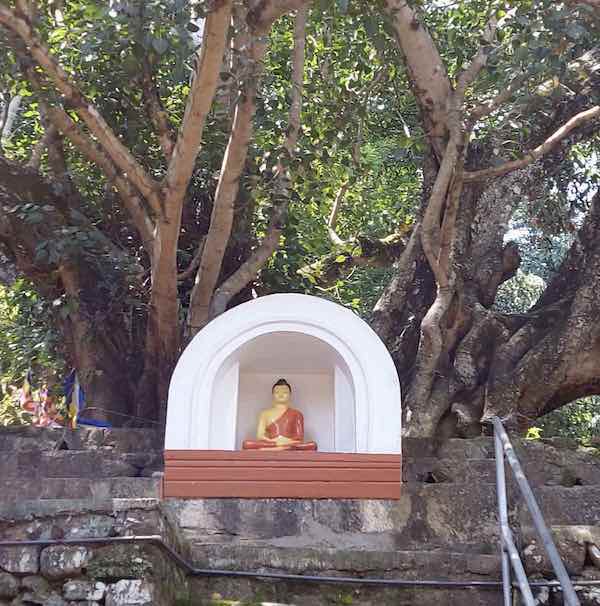
Bo tree (Ficus religiosa) and The Tooth Relic
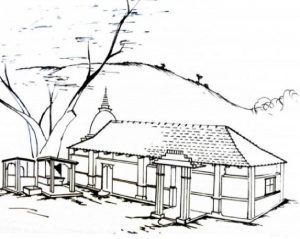
To the left of the 4 pillared archway is a Bo tree (refer sketch). Apparently the tooth relic was kept there when it was being hidden for safety during the war years. Of the many places the tooth relic was hidden this is the last and 4th place after Pusulpitiya Raja Maha Vihare. This war is in reference to the battles that culminated with the Kandyan Convention and the acceptance of King George the III as our King. The transition also saw the disposing of the last “Sinhala” King, Sri Wickrema Rajasinghe who was of Dravidian descent in 1815.
It was from this very temple that Ehelepola Maha Adigar, with hopes of being the new King, accompanied by John Doyle, brought the tooth relic to the Sri Dalada Maligawa in a grand procession.
Dethis Bodhiya in reference to the 32 saplings that were taken from one of the 8 saplings of Sri Maha Bodhiya is found above the current Bo tree.
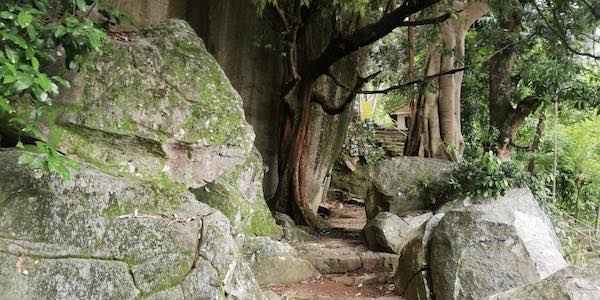
Path through the boulders
The temple lies at the foot of a huge boulder which leans over it as though to engulf it within its mouth. Two hundred and thirty stone steps lead up from the road to the foot of the boulder. Half way up (104 steps) is a recently built bana maduwa on the left, with the pansala farther back.
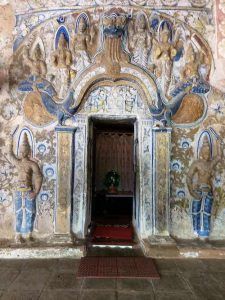
From here another 126 steps take one to the foot of the 4-pillared archway entrance, which serves both as a belfry and as the entrance to the temple precincts. The flat roof of the belfry is crowned with a small dagoba, and four worshipping figures, one at each corner.

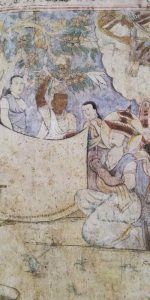
The vihara lies tucked in under the overhanging rock and has a lean-to roof supported by Kandyan-style wooden pillars. The facing wall of the vihara is painted with a large mural depicting Sujatha making an offering of milk-rice to the Buddha.
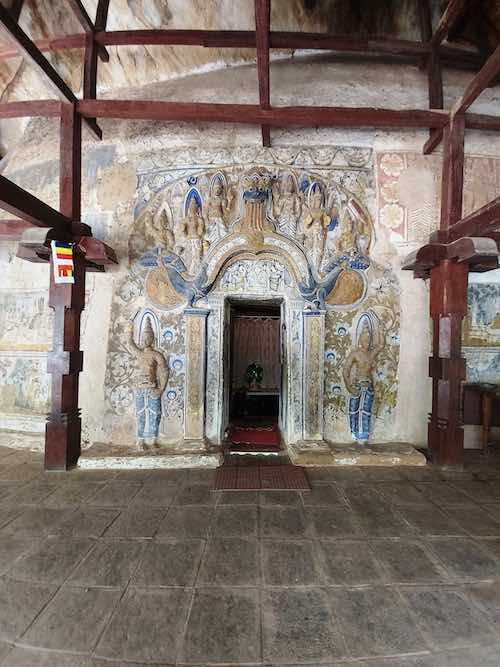

Inside the image house
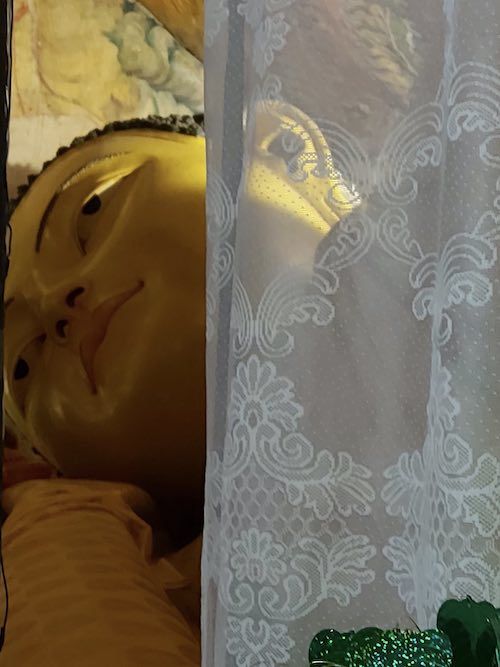
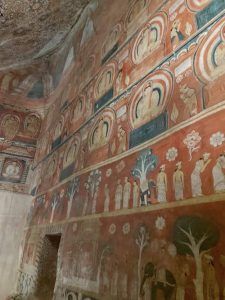
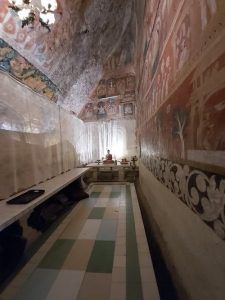
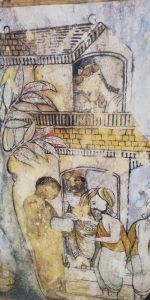
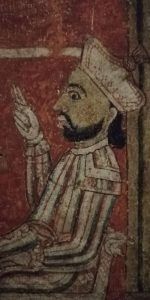
Through the torana entrance and within the cave is a colossal reclining Buddha image (recent) and two sedant images of the Gampola period. These lie against the wall at the foot of the main image. A small square window by the head of the main image gives barely sufficient light to delineate the murals within. These are mostly Jataka stories relating to the incidents in the previous lives of the Buddha (Birth stories). Some also depict the social mores of the Kandyan period, eg., a stall displaying two jak fruit and two bunches of bananas suspended from a horizontal pole. Others show the people bringing in the harvested paddy in sacks. One panel displays the King entering the royal bed-chamber. His consort lies asleep on a couch, a spittoon on the floor beside her.
Ceiling depict the story of “Mara parajaya”
On the ceiling, besides the usual floral designs, are paintings depicting the battle with Mara (Mara yuddha); arrows directed at the Buddha are shown flying back to the enemy. Behind the main image, on the bare rock, is painted His emanations in rather garish colours, suggesting a recent renovation.

Some of the remarkable wall paintings of Hindagala Raja Maha Vihara
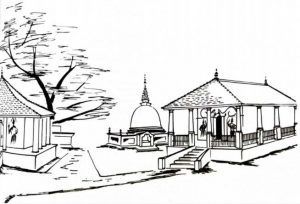
The bodhi maluwa
The bodhi maluwa outside faces the vihara but at a higher level, and separated from it by a small mal-asana. Two rock inscriptions (almost indecipherable though in Sinhala script) are extant and support a 6th or 7th century origin. One is easily accessible on a rock face buried in a recess in the foreground a little way from the belfry. The other is on the top of the boulder.

The second cave
In a second cave at the foot of the boulder and reached by going down a step or two at the belfry entrance, is a small dagoba fitting snugly into the recess below the same rock. The walls of this cave are bare.
The parapet wall
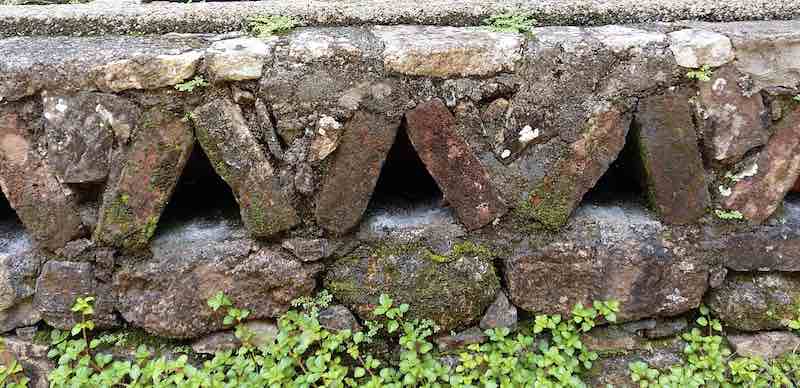
A bemme demarcates the boundary of the temple precincts and overlooks a tiny waterfall at the far end down below.
The paintings on the rock face above the vihara are no longer discernible. But according to such authorities as Hocart and Devendra, who had the opportunity to examine them while they were still in good condition, they resembled in both style and technical workmanship the paintings found at Sigiriya ie., 6th or 7th century. This would date the original temple.
Reference –
- Paranavitarna, in University History of Ceylon, 1959. Vol. I. PI, p. 408.
Dhanapala. The Story of Sinhalese Painting, p. 15. Saman Press.
The Nampotha Sahitha, though, claims the original cave temple was built by Valagambha the 1st Century B.C., and was renovated in subsequent years