
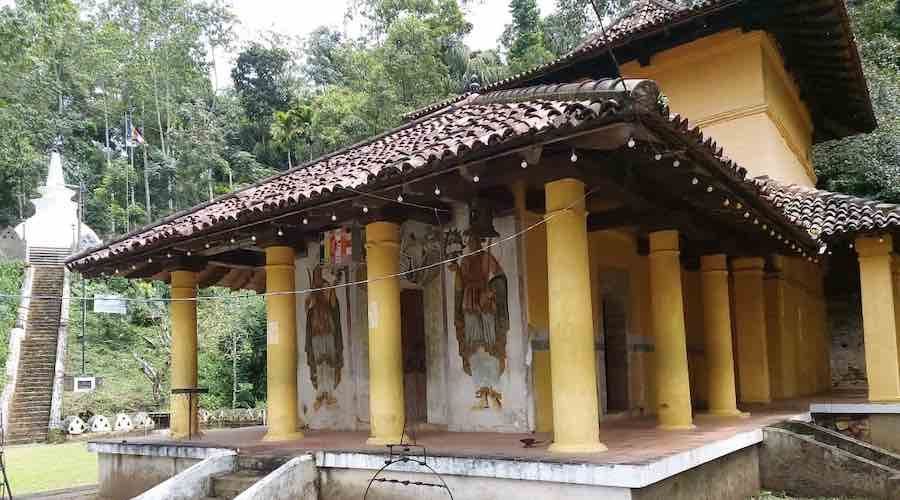
Base camp against colonialism
A vihara that has, like many of the others, become caught up in history It was the home of the Venerable Wariyapola Sri Sumangala Thera famed for his efforts to save the sacred Tooth Relic from Capture by the British.

The Thero was subsequently arraigned on some trumped up charges and executed. Another story attached to his name, one that is still being debated by historians, relates to the same Thero having pulled down the British flag and hoisting the Lion flag of Ceylon at the time of the signing of the Kandy Convention in 1815 which ceded the Kingdom to the British.
Whether this last incident is historical fact or not, the Thero has become a national hero in the eyes of the Sinhala people, and fame attaches to the temple for that reason.
History of the Vihara
During the Kandyan period (15th – 19th century), it was one of four temples (the others being Nittawela, Dalukgola and Gangaramaya) that were required by the king to give shelter to visiting monks arriving, for festivals and ceremonies, from any part of the Island.
The vihara lies snugly on the side of the foothills of the Hantana range, and
just outside the limits of the former royal city of Kandy. It overlooks the “paddy fields of the gods”. Called Deiyan-wela in Sinhalase
A story connected with the origin of the name, suduhumpola, relates that during its early days, when the king himself visited the temple on a tour of inspection, a white cloth was laid out in his honour for him to step on; hence the name Suduhumpola or :Where the white cloth was laid”
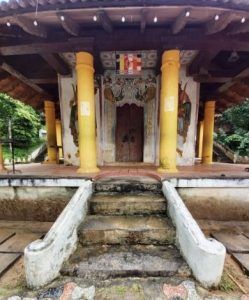
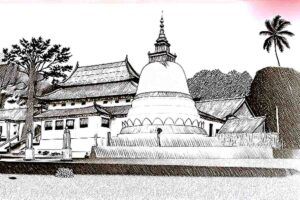
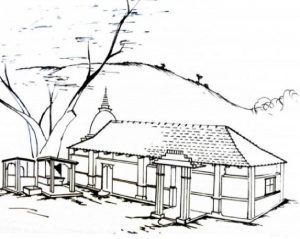
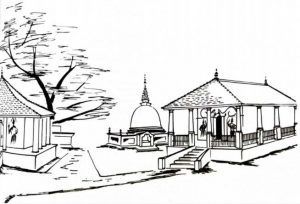
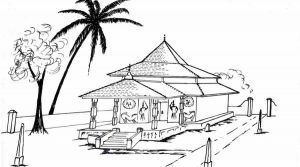
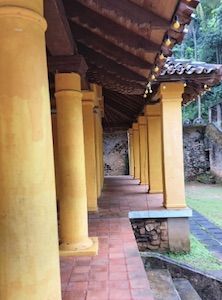
The temple was built by Kirti Sri Rajasingha in 1769. The present complex consists of the old pansala (renovated exteriorly), an old bodhi tree, a poya-gė, and the vihara and ceitiya. Access is motorable right up to the pansala building, but a more picturesque approach is by way of stone steps climbing up the side of the hill from the road below. The pansala contains many old and interesting features including carved wooden pillars, as well as its general arrangement which does not appear to have been very much altered.
This consists of twelve cells for the visiting monks, which open on to an inside verandah that surrounds a central open-air area, the meda midula or central courtyard, an arrangement still found in many old walauwas of Kandy. Each cell used to have its own cooking facilities, but this has now been usurped by one common kitchen for the whole pansala.
Within the meda midula is a low building which serves as library, meeting place and discussion room for the priests as well as for decision making.
The entrance to this open dwarf-walled inner hall faces the main entrance to the pansala, and boast of four beautiful carved wooden pillars (rather like those at Embekka devale) of jak-wood.
From the Pansala and across the front court, a few steps lead up to a Slightly higher level of ground which supports a meditation hall, and behind this, the old bodhi tree.
Another few steps and one is in the vihara precincts.
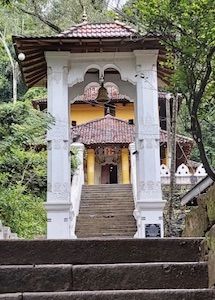
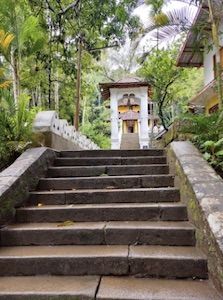
From here the stone steps, referred to earlier as a picturesque approach, can be seen descending in several flights to the main road far below. The vihara has an open verandah on all four sides, and a main entrancefound mentioned in the royal sannasa.
Surmounted by a makara torana. This leads into the drummers’ hall with undecorated walls and then into a second, smaller hall also undecorated except for a large modern oil painting of the “pulling down of the flag” incident.
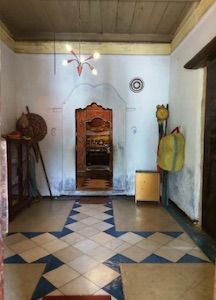
This lies against a blank wall on the right, still awaiting final placement. Then through a narrow doorway and over a single stone step into the inner sanctum or budu-ge.
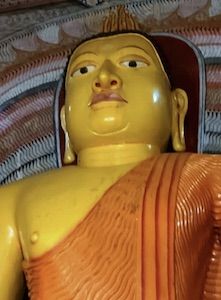
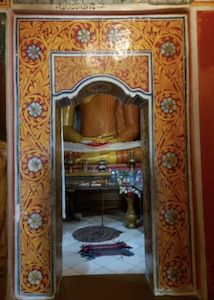
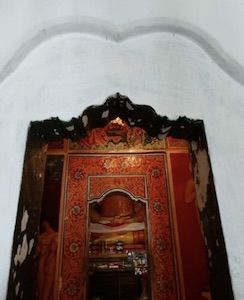
Within, facing the door, is a large sedant Buddha image, original but recently overpainted.
The image sits on a vajrasana but separate from the wall behind which is so painted with the nimbus of His emanations as to appear of one piece with the statue in front of it. Apart from this one Buddha image, the shrine room contains no other images either large or small. The walls are remarkable for their original paintings which are still in very good condition.
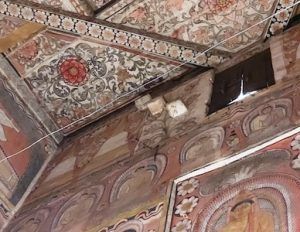
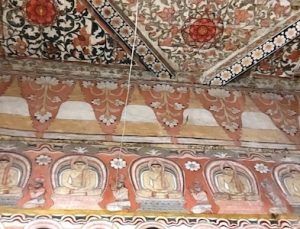
They are arranged in three horizontal rows. The lowermost of these rows on all three walls (excluding the back wall) shows worshipping monks all facing in one direction, viz., towards the Buddha. They have their hands held together in worship.
The topmost row of murals depicts the solosmastana or 12 sacred places a good Buddhist must visit. The chief prelate Suduhumpola Godamunne explained that Two of these might be mentioned as the Mahaiyangana dagoba is shown in 3 layers to indicate that it had received three renovations or restorations, and the central picture of the top row on the right wall which shows a symbolic representation of Sri Pada, the sacred mountain, as a loaf-like black rock with a gangway of steps running to the top on which is displayed a large flat footprint standing on its side and facing the centre of the room.
The footprint is housed under a canopy-like building drawn flat but correctly up-right unlike the tipped-up footprint itself.
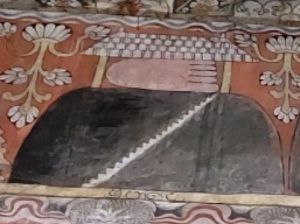
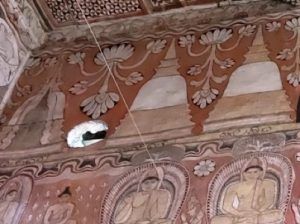
The other sacred places including Sri Maha Bodhiya and Ruwanveliseya are depicted in the same row around the room.
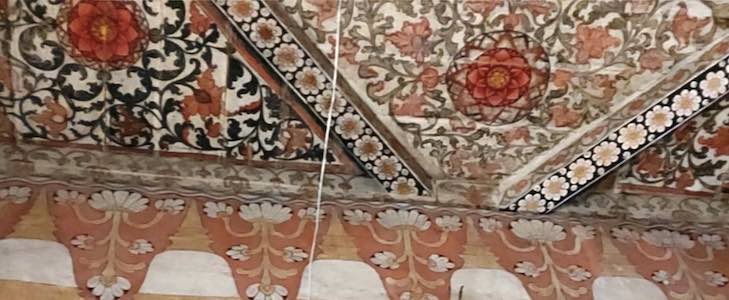
The ceiling is covered with floral designs with a large lotus centrally.
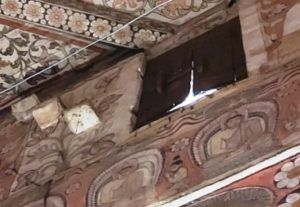
Two square windows on each side wall and one window high up facing the Buddha image are the only sources of light and ventilation once the entrance door is closed.
The floor of the shrine room is covered with marble-like tiles, each about one foot square. If one kneels on the stone step at the entrance to the shrine room, one notices that the half-closed eyes of the Buddha image are looking directly down at you.
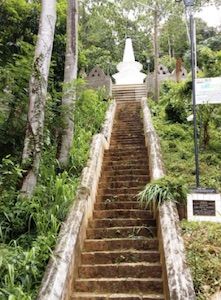
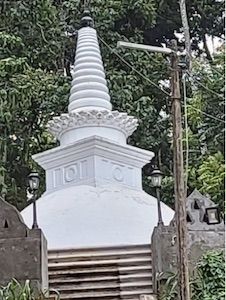
The dagoba on the left of the vihara is at a still higher level. It is a recent one, the pinnacle having been ceremoniously placed in position during the time of, and by, the then Prime Minister, D.S. Senanayake. The dagoba itself is of the bell-type.